
A flower
Ground Level
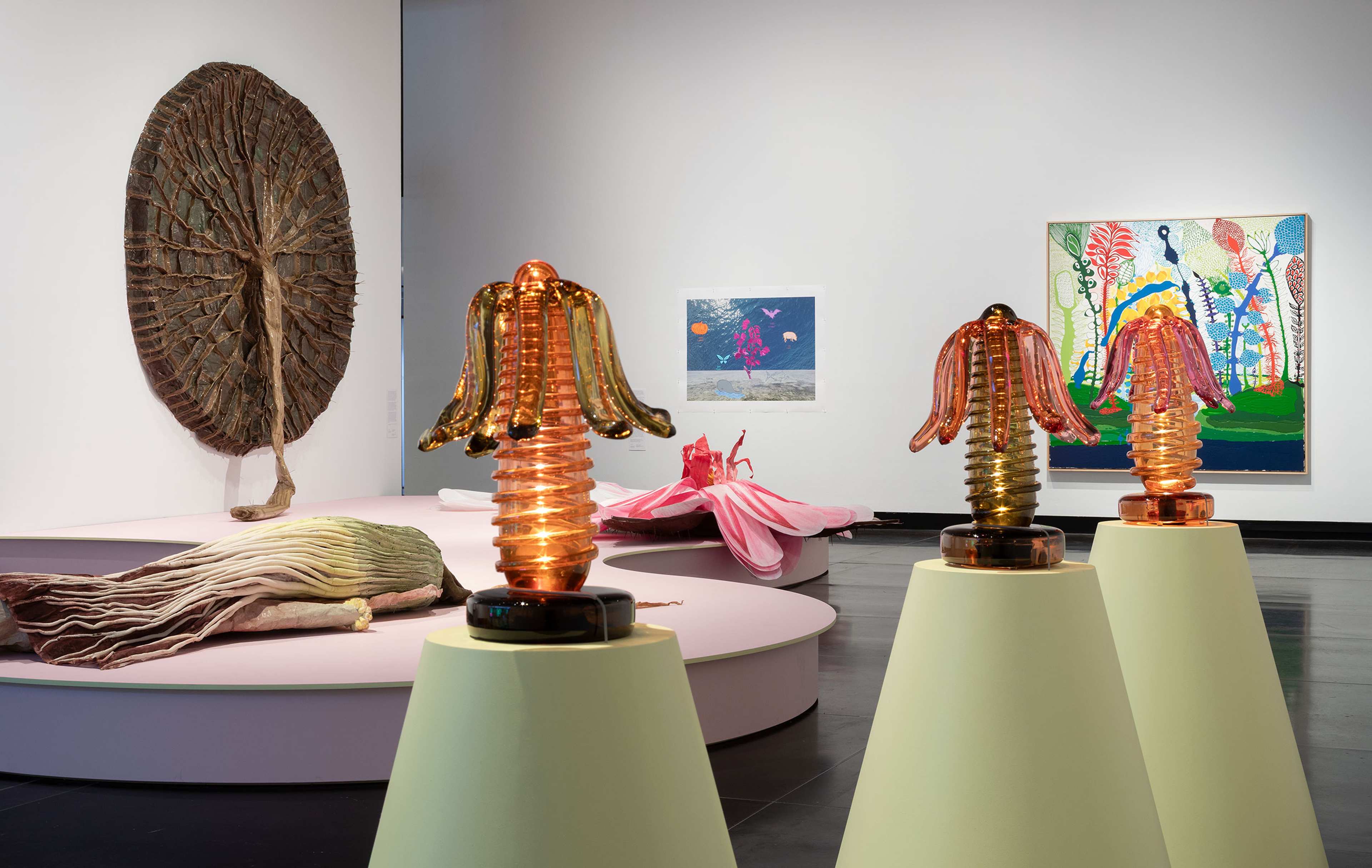
Installation view of A velvet ant, a flower and a bird, Potter Museum of Art, the University of Melbourne, 2026. Photography by Christian Capurro.
Flowers have long been understood as sources of knowledge. In the eleventh century, Deviribus herbarum by Odo of Meung described the powers of plants in poetic verse. The book reflects a belief that nature could reveal healing and order in the world.
In this exhibition, flowers suggest another possibility. What if humans learned from them instead. Flowers grow through cycles of change, loss and renewal. They transform sunlight into colour, scent and form. The works on this level invite us to imagine a relationship with nature built on attention, sensation and care.
A similar spirit of curiosity appears in Telephone Tales by Gianni Rodari. In the story, a boy follows a road that everyone believes leads nowhere and discovers a landscape filled with towers and flowers.
Follow the flowers and take unexpected paths, look again at the natural world.
Watch
Ingela Ihrman
Ingela Ihrman’s works transform familiar botanical forms into large, embodied presences. Made from textiles, papier-mâché and handy materials, such as packing tape and golf tees, her flowers are not costumes but alternate bodies or forms she steps into, to inhabit the life of a plant from within.
By becoming a bud, a bloom, or a species with unusual reproductive behaviour, Ihrman explores how the agency, desire and complexity of plants often goes unnoticed. Her choice of species is deliberate. She gravitates toward flowers whose biology unsettles human expectations: self-fertile passionflowers, giant waterlilies that trap their pollinators, plants whose dramatic cycles of opening and closing hinge on scent, timing and vulnerability. These botanical ‘exceptions’ expose the limitations of viewing nature as passive, decorative or powerless. Through slow, meticulous making and performance, Ihrman invites viewers to imagine what it might mean to feel, move and respond as a plant. The flowers become soft architectures of thought – structures through which to consider humility, interdependence and the possibility of becoming other. They suggest that agency can take many forms, and that life perceived as still or delicate may in fact be dynamic, strategic and full of force.