A velvet ant, a flower and a bird Commissions
Several new works have been commissioned for A velvet ant, a flower and a bird. These commissions extend the exhibition’s reflections on intelligence and our relationships with the natural world. Commissioning artists include Anthony Romagnano, Daphne Mohajer va Pesaran, Derek Tumala, Gracia Haby and Louise Jennison, Miles Howard-Wilks and Noriko Nakamura.
Available to view in the current exhibition, A velvet ant, a flower and a bird, until 6 June 2026.
Anthony Romagnano
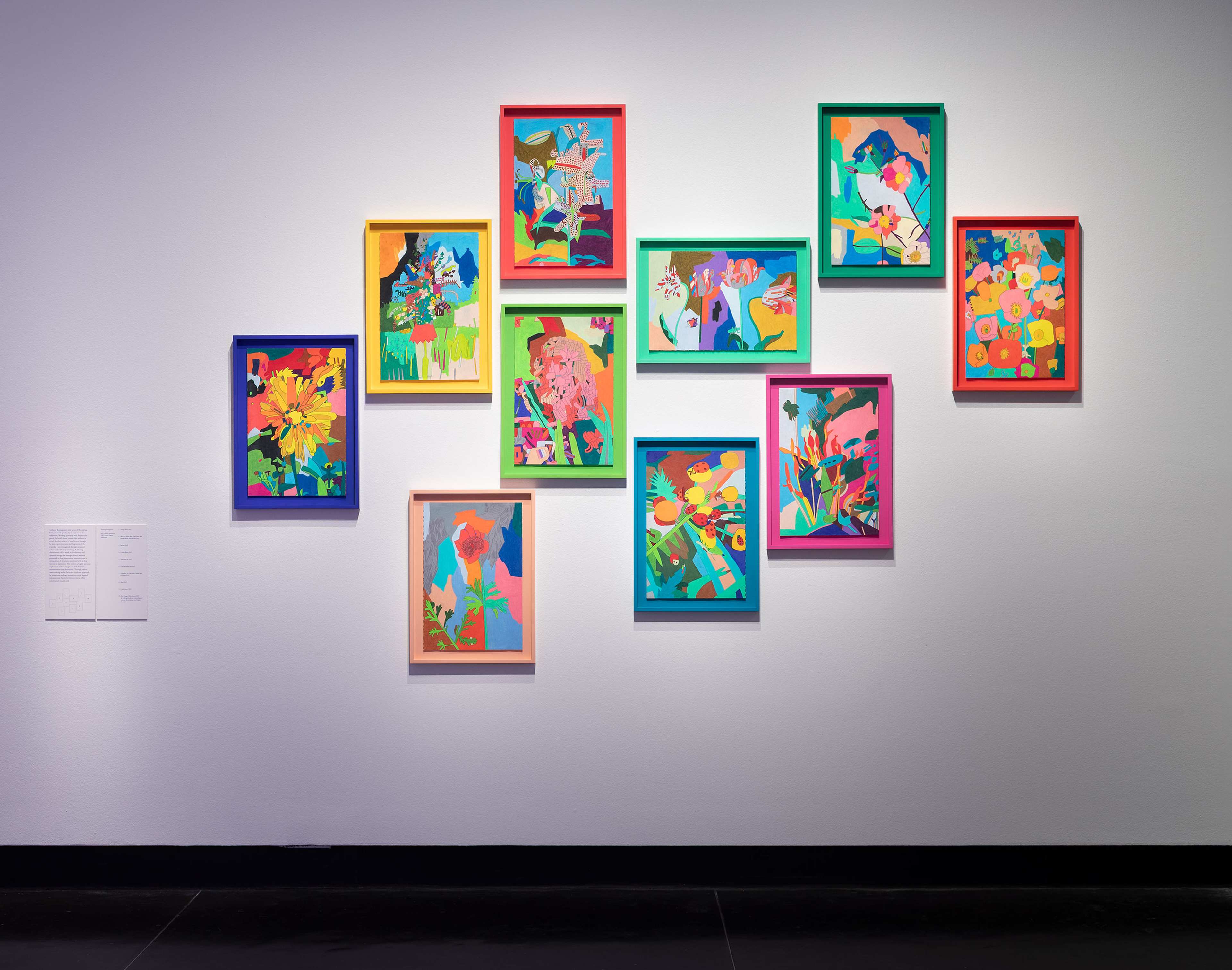
Installation view of A velvetant,a flower and a bird, Potter Museum of Art, the University of Melbourne, 2026. Featuring works by Anthony Romangnano.PhotographybyChristianCapurro.
Anthony Romagnano’s series of flowers has been specifically produced in response to the exhibition. Working primarily with Prismacolour pencil, he builds dense, mosaic-like surfaces in which familiar subjects—here flowers, though he also depicts portraits and fragments of the everyday—are reimagined through saturated colour and intricate patterning. A defining characteristic of his work is the vibrancy and dynamic energy that emerges from a method grounded in close observation, repetition, and a strong sense of structure, combined with a deep interest in expression. The result is a highly personal exploration of how images can shift between representation and abstraction. Through patient mark-making and a distinctive rhythmic approach, he transforms ordinary scenes into vivid, layered compositions that invite viewers into his richly constructed visual world.
Daphne Mohajer va Pesaran
Solar rope 2026
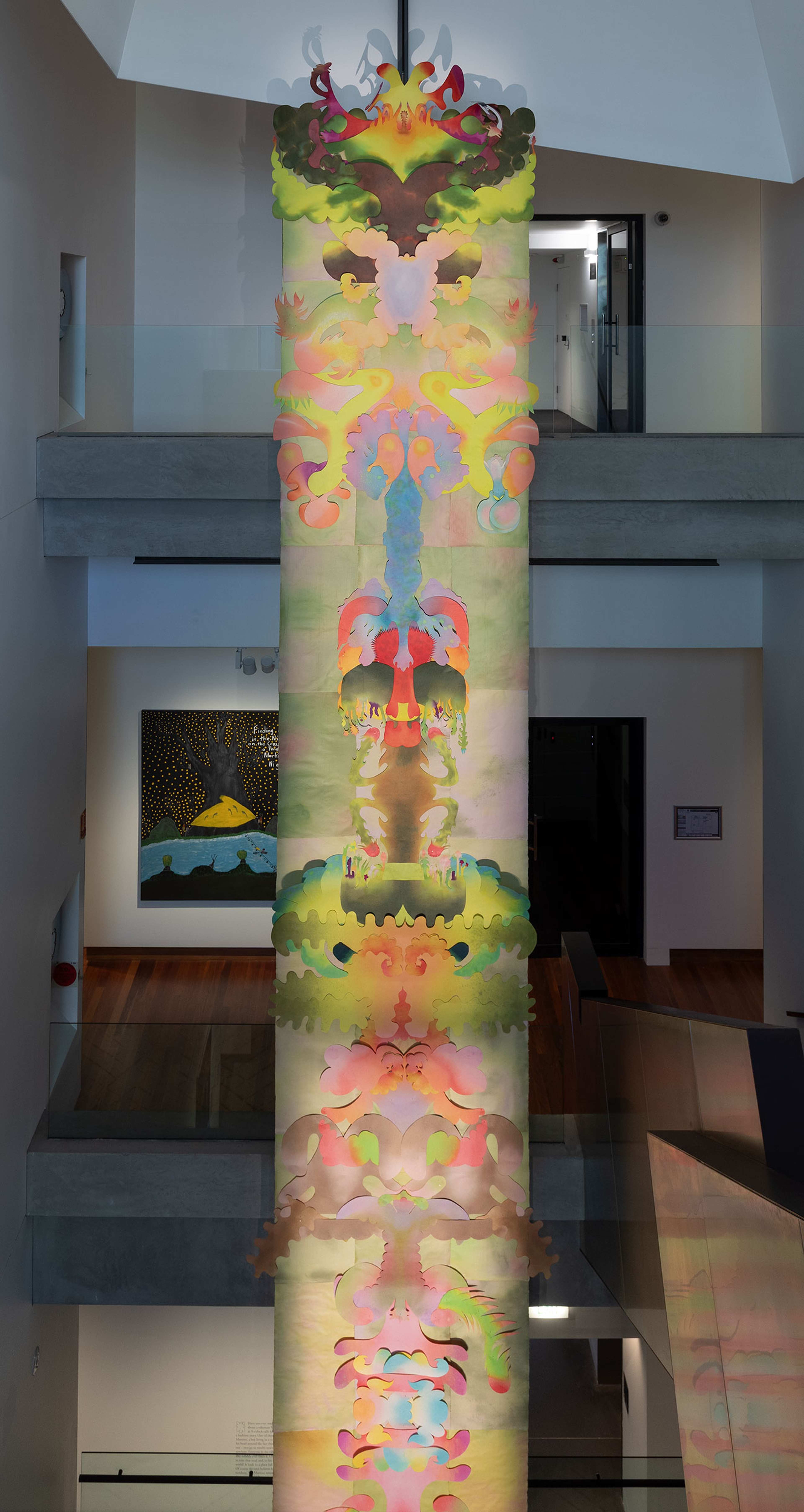
Installation view of Avelvetant, a flower and a bird, Potter Museum of Art, the University of Melbourne, 2026. Featuring Daphne Mohajer va Pesaran, Solarrope 2026, courtesy the artist. Photography by Christian Capurro.
Daphne Mohajer va Pesaran’s practice revolves around paper as a resilient, sustainable and political material. Paper is an ancient technology and a keeper of memory and imagination – born in China more than two thousand years ago and carried across cultures as a medium for writing, ritual, clothing and exchange.
This new piece – a second skin over an existing architectural feature– is a layered, plant-like construction echoing paper’s role as an intermediary between the natural and human worlds. Each colour-saturated piece recalls petals, leaves, and the internal architectures of flowers. As the shapes are superposed, they form a vertical organism that seems to grow upward – part dress, part spine, part devotional object.
The interplay of overlapping forms produces a sense of movement, as though the piece were continually reorganising itself. It recalls the intuitive processes of folding, unfolding and hybridising that shape both paper usage and natural growth, while also invoking the logic of totems or talismanic structures.
Derek Tumala
Kayamanan ng Pilipinas (treasures of the Philippines) 2025-26
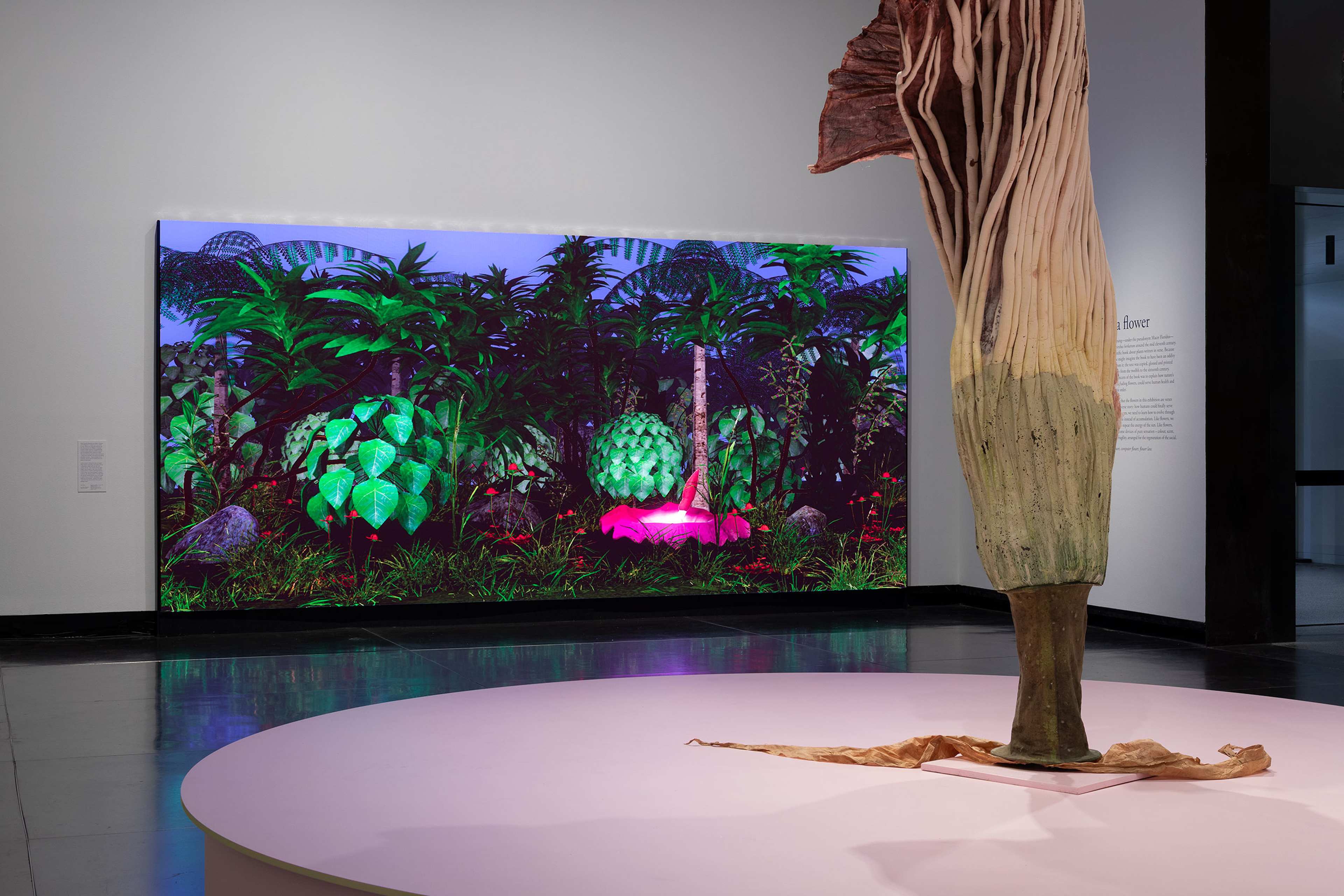
Installation view of A velvetant, a flower and a bird, Potter Museum of Art, the University of Melbourne, 2026. Featuring Derek Tumala, Kayamanan ng Pilipinas (treasures of the Philippines)2025-26; Ingela Ihrman, Amorphophallustitanum 2013, courtesy the artists. Photography by Christian Capurro.
Derek Tumala’s Kayamanan ng Filipinas (Treasures of the Philippines) is a digital movie that unfolds as a new version of an earlier piece with the same title. Drawing from the Philippine archipelago’s vast flora, Tumala constructs a moving landscape in which endemic plants are modelled, animated, and choreographed within a generative system. The work is driven by real-time weather information—temperature, humidity, wind patterns, and shifting atmospheric pressure—which modulate colour, luminosity, speed of transformation, and the density of visual layers.
As the climate outside fluctuates, the digital plants respond, expanding, contracting, pulsing, or dimming in subtle shifts that link code, ecology, and time. This interplay between plant imagery and atmospheric data echoes Tumala’s broader practice, in which technology becomes a tool to sense, record, and reimagine ecological conditions. By allowing weather to literally shape the artwork, Tumala positions nature not simply as subject but as co-author, reminding us how deeply our environments—physical and digital—are interwoven with the forces that sustain or endanger them.
Gracia Haby and Louise Jennison
Specimen 1963 2026
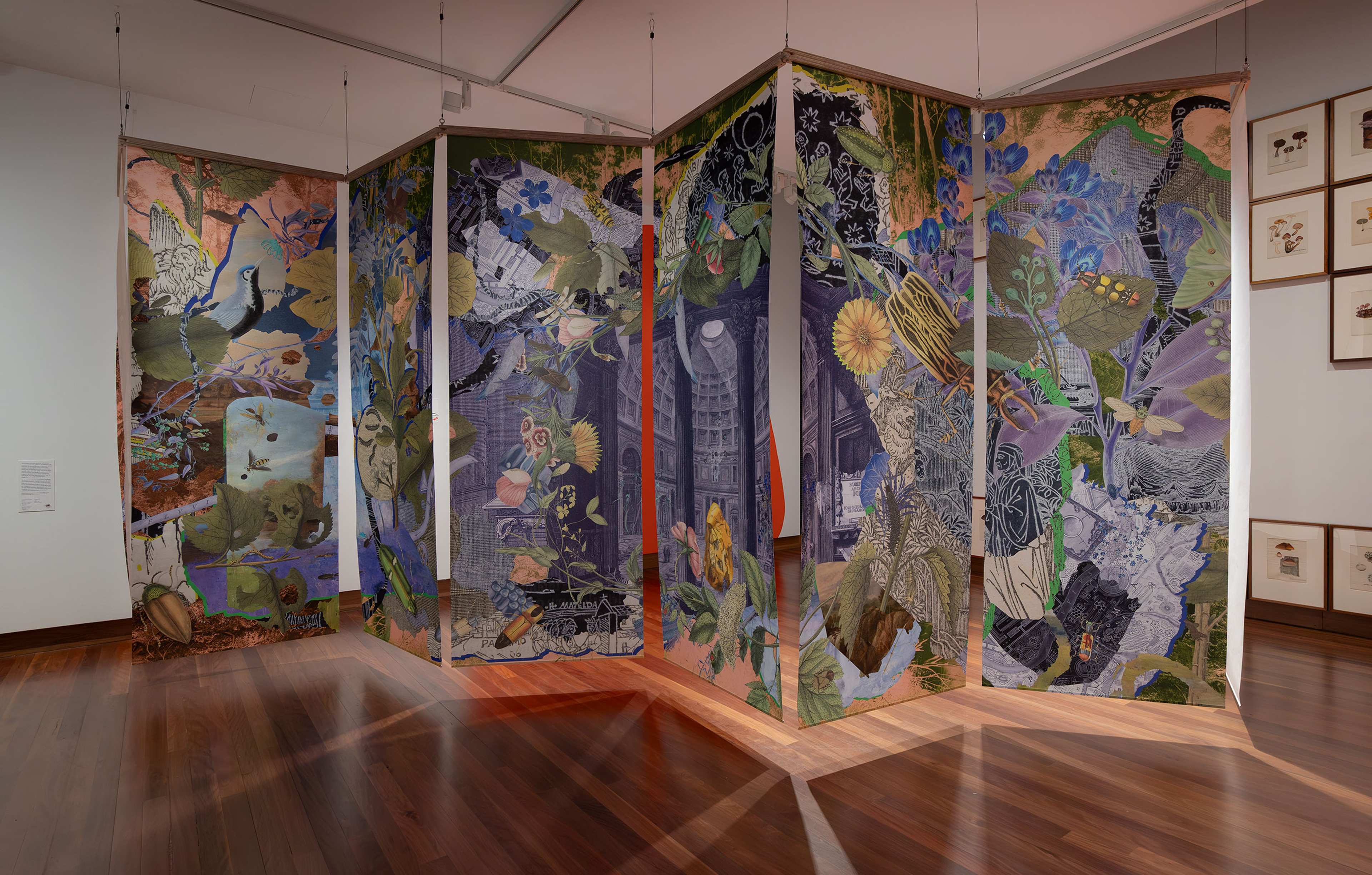
Installation view of Avelvetant, a flower and a bird, Potter Museum of Art, the University of Melbourne, 2026. Featuring Gracia Haby and Louise Jennison, Specimen 1Sc3 2026, courtesy the artists. Photography by Christian Capurro.
Gracia Haby and Louise Jennison’s work, commissioned for this exhibition, is dedicated to the velvet ants of Australia. A series of suspended folding screens compose a digital collage rooted in the artists’ long-standing practice with natural-history research, paper, print and collage. The format allows them to conceive a pedagogical, narrative work that integrates rare book natural history illustrations and science, while also reflecting on their ongoing engagement with nature and biodiversity. The format has a function: it becomes a handmade transmission machine. Fold by fold, panel by panel, Haby and Jennison tell and show moments in the history and behaviour of a given species – the velvet ant. Engagement, commitment, and the desire that all of us might participate more actively in the lives of animals and plants, animate a practice that insists on better, more attentive forms of coexistence.
Miles Howard-Wilks
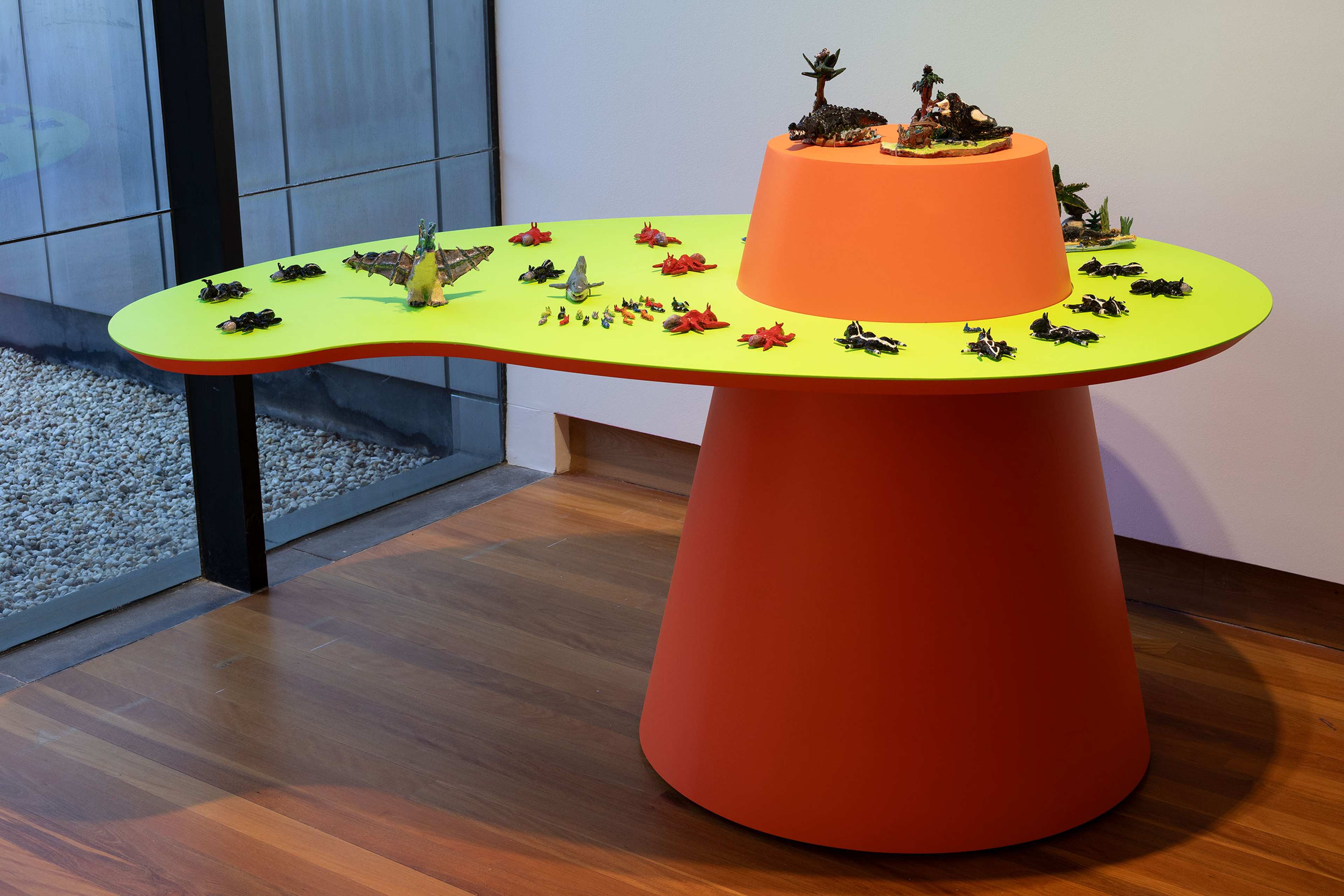
Installation image of A velvet ant, a flower and a bird featuring the commissioned work of Miles Howard-Wilks. Photography by Christian Capurro.
Miles Howard-Wilks joined Arts Project Australia in the early 2000s, developing a distinctive visual language across drawing, painting and, more recently, ceramics. This commission for the exhibition, expands his exploration of three-dimensional form in clay and his long-standing fascination with animals and the natural world. In this piece, Howard-Wilks turns to ants – creatures known for their collective intelligence, adaptability and intricate social structures. Formed in ceramic, their scale and repetition lend the work an animated, almost comic presence. Throughout his practice, Howard-Wilks draws attention to the extraordinary within the everyday, revealing how nature and the animals that inhabit our planet possess an incredible sense of expression and eloquence.
Noriko Nakamura
Magnolia lover 2026
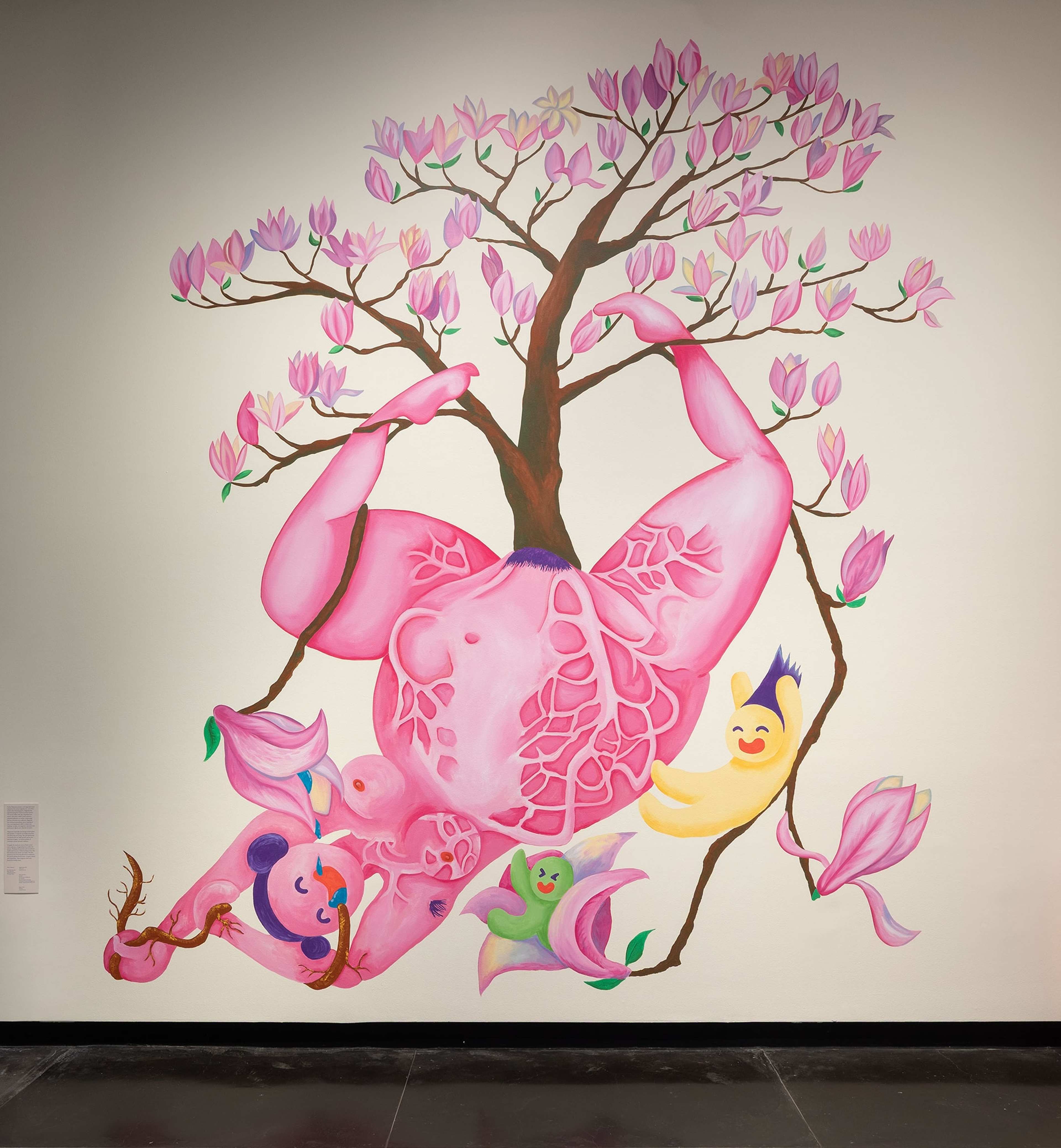
Installation view of A velvetant, a flower and a bird, Potter Museum of Art, the University of Melbourne, 2026. Featuring Noriko Nakamura, Magnolia lover 2026, courtesy the artist. Photography by Christian Capurro.
Noriko Nakamura presents a large-scale mural inspired by the ancient Magnolia tree—one of the world’s oldest flowering species. Magnolias first appeared during the Cretaceous period, between 142 and 65 million years ago, long before bees existed. Their thick, resilient petals evolved to withstand pollination by beetles, a relationship that has continued across millennia. As some of the earliest flowering trees on Earth, magnolias have witnessed extraordinary spans of geological time, surviving dramatic shifts in climate and landscape. In Japan, the Magnolia is associated with perseverance, dignity, and a deep love of nature.
Nakamura’s mural takes this lineage as both subject and metaphor. A Magnolia tree stands in her front yard, blooming each spring. This recurring cycle has become intertwined with her child’s growth and her own experience of aging—an annual reminder of continuity, renewal, and quiet resilience.