
Curating Ngarn Wa'ngal
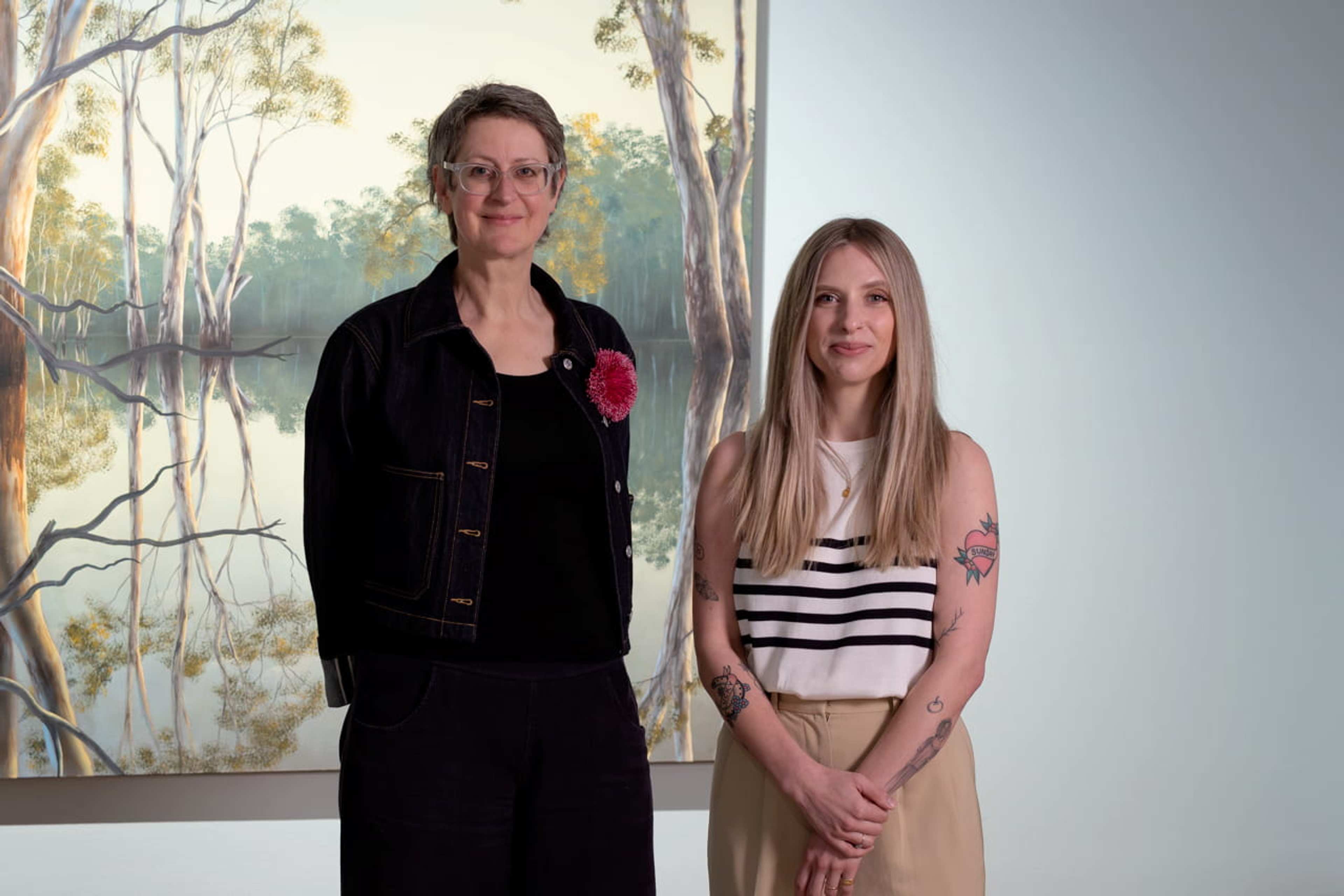
Image of Alisa Bunbury and Sophie Gerhard, curators of Ngarn Wa’ngal: Art of the gum tree. Featuring Lin Onus, Floodwater 'Woorong Nucko', 1995, courtesy of the Carillo and Ziyin Gantner Collection. Photography by Christian Capurro.
In Ngarn Wa’ngal: Art of the gum tree, curators Alisa Bunbury and Sophie Gerhard draw from the University of Melbourne's collections alongside significant local and interstate loans to reconsider the eucalypt as an iconic symbol and a living subject that continues to shape artistic, cultural and environmental narratives.
Alisa, you’ve been working on this exhibition slowly behind the scenes for close to ten years. What is it about the gum tree that has kept you captivated for so long?
Alisa Bunbury: Yes, this show had a long germination period. I first proposed it at the interview for my current position almost 10 years ago. I work with the Grimwade Collection – art, books and archives donated to the University of Melbourne by Russell and Mab Grimwade. Russell was a eucalyptophile – he was devoted to gum trees throughout his life, and it seemed a perfect topic to focus on. Since that time, there have been exhibitions such as the Powerhouse’s Eucalyptusdom exhibition but none that have focused particularly on gum trees in Australian art, and through that, their role in our daily lives.
Like most Australians, I have had a life-long association with gum trees. I grew up in Heidelberg, above the Birrarung floodplains, where a massive river red gum lived for hundreds of years (certainly pre-invasion). The smell of a lemon-scented gum planted by my parents is part of my childhood, as is the memory of raking up all the bark they drop. I never got bored of this project – in fact, it was the reverse. There’s so much to learn, so many species of gums across Australia, and each tree has its own distinctive quality. It’s helped me to appreciate them much more, and to understand more about First Nations people’s deep connection with them, as well as the problem eucalypts are causing through their introduction to environments overseas.
The phrase ‘home among the gum trees’ feels warm and familiar to many Australians, with gum trees themselves being deeply tied to Australian identity. Why do you think they’ve become such a powerful national symbol?
Sophie Gerhard: For such a multicultural and pluralist country, there aren't many things that have the ability to unite so many of us. Gum trees are everywhere, and I think it's in their ubiquitousness that they've become such a part of our collective identity. Although there are hundreds of species across so many shapes, sizes, textures and scents, they carry a nostalgia and familiarity that can transport us to a simpler time – a childhood backyard, a camping trip, a hot afternoon. It's visceral in a way that most other national symbols aren't.
That said, the idea of a 'national symbol' is worth interrogating, especially in a colonised country. For something so organic and unassuming, it's important to remember that the gum tree has been deliberately harnessed to speak for a particular version of Australianness, and that version has a history. This exhibition interrogates how depictions of the gum have developed alongside colonial projects of land ownership and belonging and aims to hold some of those histories to account.
The name “eucalypt” comes from the Greek word meaning “well-covered.” What does the history of naming these trees reveal about European scientific culture at the time?
AB: Australia was colonised/invaded in the late eighteenth century when European exploration and imperialism was increasing exponentially. A key aim was of course economic benefit, the ‘discovery’ (definitely in inverted commas) of anything that could be profitable, either grown on the land (crops and stock) or taken from the land (think mining as well as plants). Naming something is also an act of claiming it, and naming Australian plants inserted them into the European taxonomic hierarchy of plants, which were being collected from around the world. The hundreds of First Nations’ nations already had names for the gums that grew upon their Country – one being wurun, for the manna gum, which is in the name Wurundjeri.
Eucalyptus, ‘well-covered’, refers to the cap (operculum) that covers the flower bud, which is pushed off as the blossom opens. Although Joseph Banks was the first European to collect eucalypt specimens in 1770 and take them to England, he didn’t name the trees. It was in fact a Frenchman, Charles-Louis L’Heritier de Brutelle, who came up with ‘eucalyptus’, based upon specimens he saw in Banks’s collection and specimens being grown at Kew Gardens, London. This name, together with the first European illustration of a gum specimen, was published in 1788 – the same year of course that the First Fleet arrived in Gadigal waters and founded Sydney. One of the very first actions ordered by Governor Phillip was to start to clear the land – to chop down trees.
In the exhibition, we have a specimen collected (taken) by Banks in 1770, and the first print of a eucalypt.
How did the British and visitors from other countries perceive gum trees in the nineteenth century?
AB: The British involved in the early colony of New South Wales, and then Van Diemens Land (Lutruwita / Tasmania), had mixed responses to gum trees, ranging from admiration for the tall spreading trees to dislike of the endless forests, which they found sombre and gloomy – unfamiliar. The tallest trees didn’t always lead to the best timber, often having hollows that are of course important habitat for birds and mammals. For their settler aims, however, timber was essential for buildings, fences and fuel, and cleared land was wanted for pastures and crops. A fair number of people realised that landscapes had been maintained by Aboriginal cultural burning, but fire management is difficult once permanent timber structures are built. John Glover is one of the best known early colonial artists who depicted paddocks filled with cattle, on land clearly maintained by regular burns. This practice was stopped in Lutruwita when the Palawa people were murdered, rounded up and forced off Country. As Julie Gough shows in her moving multi-screen video work Witness, the old gums that still survive were witness to these events.
Sophie, you’ve spoken about how settlers tried to create a sense of belonging through the Australian landscape. Do you think Australians are still searching for that connection today?
SG: Throughout the nineteenth and twentieth centuries, non-Indigenous Australians were longing to feel at home in a country they didn't have ancestral connection to. So, the idea of what made Australia – the symbols, the stories, the imagery – was purposeful and constructed. The gum tree played a huge role in that.
Today, that connection to place exists in a way it didn't two hundred years ago. People have roots here now, families going back generations. But I think there's still a restlessness, and I believe the deeper, more honest conversations about Australia's colonial past are where a truer sense of belonging will come from. That's an ongoing process, and it should be.
Throughout the exhibition, you've challenged some nostalgic Australian imagery including gum trees, bush life and even May Gibbs’ gumnut babies. Why is it important to revisit these symbols critically?
SG: I think when something is so deeply embedded in our consciousness, it can go uncritiqued. It hides in plain sight, without anyone questioning how it got there or what it might be carrying.
May Gibbs is a good example. To many, Gibbs' gumnut babies are lovely. They’re imaginative, warm, and responsible for introducing generations of children to the native landscape. I don't think you need to throw that out. But context matters. The first Snugglepot and Cuddlepie book was published in 1918, at the height of government assimilation policies that saw First Nations children forcibly removed from their families. When you consider this alongside the way the characters function – idealised white babies born from the bush, indigenising the settler experience within the native environment – a more complex picture emerges.
Do you think gum trees will be an enduring symbol in Australian art in future years to come?
AB: I’m sure they will be. As long as artists respond to our environment, they will inevitably respond to gum trees given their prevalence across this continent. How they respond, though, will change as our society and our relationship with our bush, farms, suburbs and cities develop, just as they have in the past. However, we mustn’t take them for granted. Many gums are struggling to cope with the warming climate. Think of snow gums, as a clear example. In fact, even in the nineteenth century, people were writing about the changing climate. This concern is not a new thing!
The eucalypt is prevalent in so many Australian artworks. Can you speak to the contradiction between celebrating gum trees culturally while continuing to destroy forests and sacred sites?
SG: It's a contradiction that runs right through Australian life. We put the gum leaf on our passport and then fell trees for golfing greens and highways. We adore koalas – they're our most cherished mascot – but continue to cut down the eucalypts they depend on for food, water and shelter. Koalas were listed as endangered in Queensland, New South Wales and the ACT in 2022, and in 2024 alone, the federal government approved the destruction of over 3,000 hectares of koala habitat. There's a real disconnect between the cultural reverence and the material reality.
You only need to look back to 2020, when the Victorian government felled sacred Djab Wurrung birthing trees – some over 800 years old – to duplicate a section of the Western Highway that would save drivers a few minutes. Djab Wurrung women and supporters had camped at the site for over two years trying to protect them. It was devastating, and the outcry was immense – Indigenous and non-Indigenous people standing together, more than 1,200 academics signing an open letter of condemnation. That kind of collective response shows that people do care, deeply. But it also shows how far policy still has to go to match that feeling.
After spending so much time thinking and writing about gum trees, has your own relationship to the Australian landscape changed?
SG: Absolutely. I came to this project as a curator interested in Australian art and the conversations around national identity and belonging in a colonised land. Gum trees as an emblem were part of that wider interest, but the botanical side of them was not within my wheelhouse at all. This exhibition has given me an extraordinary education. I only just found out that some eucalypts can draw up microscopic gold particles from deposits deep underground and store them in their leaves and bark. How incredible is that?! I'm learning every day, which just deepens my joy that I get to live amongst these trees. I've spoken so much about gum trees over the last few years that my four-year-old daughter is now a huge gum enthusiast!
AB: I am continually learning more about gums. Sophie mentioned that gums can take up gold from the soil – that’s pretty extraordinary. I’ve seen gumnut shapes, blossom and leaves more diverse than I ever knew existed, and such a range of artistic responses. But most importantly for me is learning about the depth of connection of First Nations people with trees as kin, totems, signposts and providers. Despite my love for and admiration of gums, I don’t have that heart-and-spirit relationship, which is a factor of my British ancestry — and my loss.
When visitors enter the exhibition, what is the first artwork they see and why did you position it here?
AB: In the first room visitors will see a selection of impressive wooden clubs marked with pokerwork designs, made by Wurundjeri artist Lewis Wandin-Bursall. Sophie felt strongly, and I agree, that this is the appropriate way to start an exhibition on Wurundjeri Country.
Was there an artwork you were really excited to include in the exhibition?
SG: I'm really excited about the five commissions we've been able to include, outcomes of their Miegunyah Creative Fellowships. Jazz Money, megan evans, Janet Laurence, Jane E. Brown and Dean Cross have each made new works in response to the exhibition, and watching those pieces come to life has been one of the best parts of the process. Each artist has engaged with the subject in a completely different way, and they bring a really exciting energy and immediacy to the show. I can't wait for people to see them!
What do you hope audiences take away from visiting Ngarn Wa’ngal: Art of the gum tree?
SG: I hope people walk away with a deepened sense of awe for these trees – for their diversity, their resilience, and the extraordinary range of ways artists have responded to them across time. But I also hope people leave feeling that the gum tree is their business. Not in an abstract, environmental-guilt kind of way, but in a personal one. These trees do so much for us – they clean our air, they shelter the wildlife we love, they carry tens of thousands of years of cultural knowledge. The title of the exhibition, ngarn wa'ngal, means 'breathing for us’. I want people to sit with that. If these trees are breathing for us, what are we doing for them? I hope the exhibition gives people not just appreciation but a sense of responsibility.
AB: I hope people will leave the exhibition feeling challenged, informed and stimulated – and maybe look at gums around them a bit differently.
Ngarn Wa’ngal: Art of the gum tree runs from 10 July to 21 November at the Potter Museum of Art.