
Introduction
Ground Level
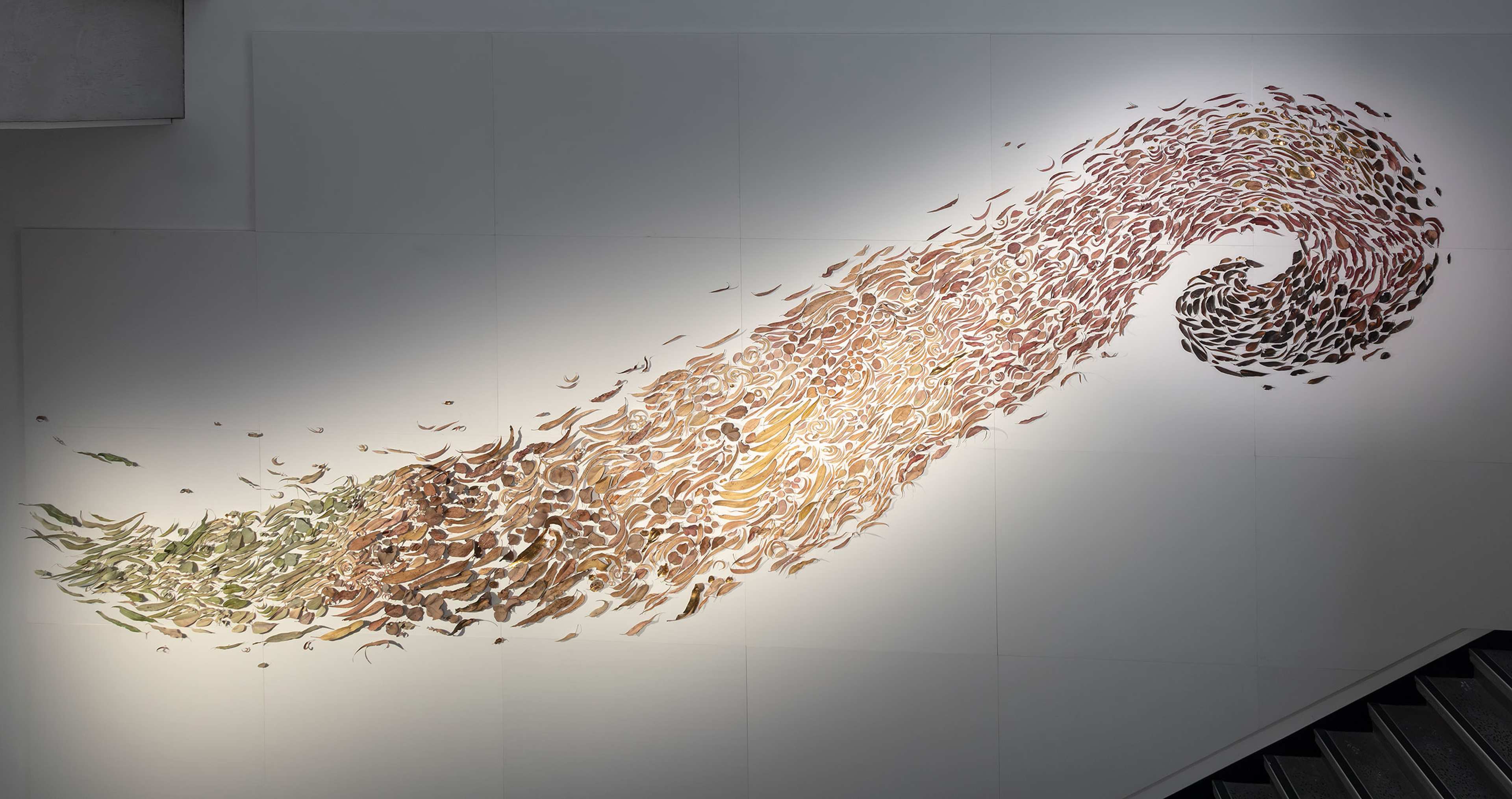
Installation view of Ngarn Wa’ngal: Art of the gum tree, Potter Museum of Art, the University of Melbourne, 2026. Featuring megan evans, Gust 2026, courtesy of the artist. Miegunyah Creative Fellowship commission, 2026. Photography by Christian Capurro.
Ngarn Wa’ngal: Art of the gum tree explores the eucalypt as a source of creative inspiration in Australian art. ‘Ngarn wa’ngal’ is Woi Wurrung for ‘breathing for us’, a title that recognises the intrinsic relationship between trees and people. From dense forests, open plains, sub-alpine mountains and arid deserts to our cities and suburbs, the gum tree connects us to this land and shapes who we are.
Over three floors, this exhibition traces the gum tree across art and culture: as a living being central to First Nations identity, an unfamiliar tree of fascination to early European botanists, a witness to the impacts of colonisation, a symbol of national identity, and a familiar backdrop to our daily lives. It also presents artistic responses to the environmental threats facing eucalypts today, and to their resilience. Together, the works of art encourage reflection on Indigenous sovereignty, Australian identity, our environment and climate, as well as the reach of the gum tree beyond this continent.
Eucalypts are indigenous to Australia, with over 900 identified species and subspecies – from towering giants and gnarled ancients to delicate multi-trunked mallees and hardy shrubs. Some eucalypts, like the river red gum, are found throughout much of the country, while many species grow naturally only in restricted areas. A small number of species cross over to Southeast Asia, New Guinea and New Britain, with fewer than five species endemic outside Australia. The gum trees that grow elsewhere – now on every continent except Antarctica – are the result of human distribution in recent centuries.
The European taxonomic classification ‘eucalyptus’ – from the Greek for ‘well-covered’, describing the capped flower buds – was first used in 1788. Eucalypts are divided into several genera, notably Eucalyptus, Angophora, Corymbia and the recently proposed Blakella. For this exhibition, the over-arching name ‘gum tree’ is used for all eucalypts. However, these trees have many names: taxonomic, such as Eucalyptus viminalis; common, including manna gum, ghost gum and stringybark; and age-old: wurun, biyal, wirrangga, pilpira, purnu, gaḏayka, karri, mottlecah, coolabah, jarrah and hundreds more.
This exhibition draws upon the University of Melbourne’s collections together with significant local and interstate loans.
Content warning
Gum trees have stood on the lands of Traditional Custodians for countless generations. They are part of living, breathing Country that was never ceded. We pay our respects to Elders past and present and to the enduring knowledge systems that continue to be practised, maintained and shared across this continent, despite great adversity.
Throughout this exhibition, some of the words and works of art reflect the history and the attitudes of the time in which they were written or created.
Please be advised: some of the works of art in this exhibition refer to the displacement and massacre of First Nations peoples, as well as environmental destruction and catastrophic events including bushfires. We urge visitors to take care when viewing.